Have you noticed your cheeks look a little less full than they used to, even though you still feel like yourself? If you’re weighing gradual collagen support against a more immediate change, which option makes sense for your goals and schedule? Keep reading and find out more.
Why cheek volume changes over time
Your mid-face is supported by a mix of facial fat, bone, collagen, and skin elasticity. Over time, these structures can change. Fat pads may shift or lose fullness, bone structure may remodel, and the skin may become less firm. The result can be a flatter cheek contour or less support through the middle of the face.
These changes are normal, but you don’t have to choose a treatment just because you’ve noticed them. A thoughtful consultation helps connect what you see with what may be contributing to it, and whether an injectable approach fits your preferences.

The key difference: immediate support or gradual collagen stimulation?
Hyaluronic acid (HA) filler is a gel placed strategically beneath the skin to add volume and support. Some HA products are specifically indicated for cheek augmentation to address age-related midface volume deficit. The change is visible right away, although early swelling can affect how the result looks at first.
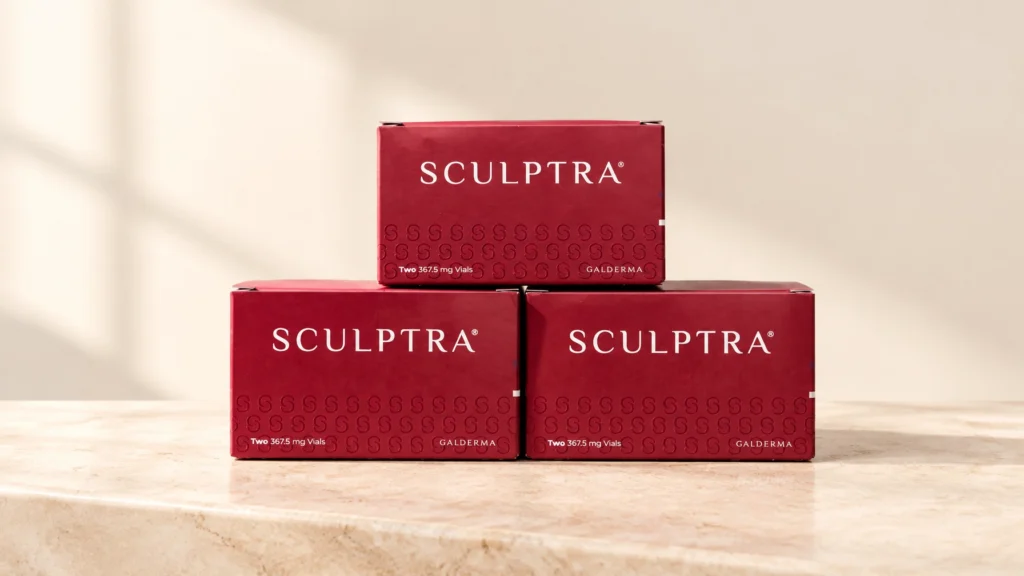
Sculptra works differently. Its active ingredient, poly-L-lactic acid, stimulates your body’s collagen production over time. Rather than providing the same immediate, gel-based volume as HA, it supports gradual change. Uplift Aesthetics notes that clients commonly need two to three sessions, with results developing over the months following treatment.
One important distinction: Sculptra’s U.S. labeling includes cheek-region fine lines and wrinkles, but that is not the same as a specific FDA indication for age-related cheek-volume augmentation. Your provider can explain how the product may fit your individual plan and goals.
When HA filler may be a fit
HA filler may suit you if you want a more immediate, targeted adjustment and prefer to assess the visible change during your treatment plan. It can be useful when the goal is to add defined support in a specific part of the cheek.
HA filler may be worth discussing if you:
- Prefer to see a change promptly.
- Want a clinician to address a specific area of volume loss.
- Value the option of using hyaluronidase to break down HA filler if medically appropriate. This is not a guarantee of instant or complete reversal.
- Prefer to make adjustments based on a visible result.
HA filler may not be the right fit if you:
- Want gradual change without an immediate added-volume effect.
- Are not comfortable with the possibility of temporary swelling, bruising, tenderness, or other injection-site reactions.
- Have an allergy, medical history, or other factor that makes the product or procedure unsuitable.
Your injector will help determine which product, placement, and amount are appropriate. A “natural looking filler” result depends on more than the product itself: facial anatomy, conservative planning, and careful technique all matter.

When Sculptra may be a fit
Sculptra may suit you if you’re open to a slower process and want to support gradual collagen development. It can be an option to discuss when your concern involves broader facial volume changes rather than a single sharply defined spot.
Sculptra may be worth discussing if you:
- Are comfortable waiting for change to develop over time.
- Can plan for a series of appointments and follow-up.
- Prefer gradual improvement rather than an immediate gel-based result.
- Understand that the product is not readily dissolved like HA filler.
Sculptra may not be the right fit if you:
- Need a visible change right away.
- Want a highly precise correction that can be assessed immediately.
- Have a history of keloids or hypertrophic scars, or another medical concern that may affect eligibility.
- Would find it difficult to follow your injector’s aftercare guidance.
As with any injectable, Sculptra has potential side effects, including bruising, tenderness, swelling, and lumps or nodules. Placement, preparation, aftercare, and your health history matter. Your provider can review the product information and discuss whether it is appropriate for you.
Could a combination approach make sense?
Sometimes a personalized plan may include both treatments, either at different visits or in a staged sequence. For example, your injector might discuss gradual collagen support alongside a smaller, targeted amount of HA filler for a specific contour concern. That doesn’t mean everyone needs both. It’s one possible approach when each product has a distinct role in the plan.
A good medical aesthetics consultation should make space for your preferences, timeline, budget, and comfort level. Ask what each treatment is intended to address, when you can reasonably assess the result, and what the plan would be if you decide not to continue with additional treatment.

What neither treatment can do
Neither Sculptra nor HA filler stops aging. Results vary, and they don’t replace a broader evaluation of facial structure, skin, and health. The goal is a considered, realistic improvement, not a promise that your face will look exactly as it did years ago.
Both options involve injections and carry risks. Common reactions can include redness, swelling, tenderness, bruising, or firmness. Rarely, accidental injection into a blood vessel can cause serious complications, including skin injury or vision problems. Seek a qualified, experienced medical professional who understands facial anatomy, reviews your medical history, explains risks clearly, and has a plan for managing complications. These treatments can be safe and effective across a broad range of skin types when appropriately selected and performed, but your individual suitability depends on more than skin type alone.
A simple way to compare the options
| Your priority | Option to ask about |
|---|---|
| Visible, targeted volume sooner | HA filler |
| Gradual change over time | Sculptra |
| More precise adjustment of a specific area | HA filler |
| Collagen stimulation as part of a longer-term plan | Sculptra |
| A tailored plan that may use different approaches | Ask about a staged combination |
These are starting points for conversation, not treatment recommendations. Your anatomy and medical history help determine what is appropriate.
Making the decision in St. Paul or Woodbury
If you’re exploring Sculptra St Paul or looking for a Woodbury med spa, begin with a consultation rather than choosing based on a product name alone. Bring your questions, explain what feels different to you, and share whether you prefer a gradual or more immediate change. It’s also helpful to ask about the exact product being considered, expected follow-up, aftercare, and potential side effects.
At Uplift Aesthetics, the team describes a consultation-first approach to planning Sculptra and dermal filler treatments. You can learn more about Sculptra in Oakdale and filler services. A conversation does not commit you to treatment; it gives you a chance to understand your options and decide what feels right.
The takeaway
HA filler offers immediate, targeted volume, while Sculptra works gradually by stimulating collagen. Some people may discuss a combination, but neither approach suits everyone, and neither stops the natural aging process. With a qualified injector, a clear plan, and realistic expectations, you can explore a treatment that supports a refreshed look while still feeling like you.