You may be noticing softer definition along your jawline and wondering what could help you look more refreshed, without looking like a different person. Could a gradual collagen-building treatment be a better fit than filler? Or are you hoping for a more defined contour right away?
The answer depends on what you want to change, your facial structure, and how quickly you’d like to see a difference. Let’s compare Sculptra and hyaluronic acid (HA) filler in simple terms, so you can feel more prepared for a conversation with an experienced injector.

Two treatments, two different approaches
Both Sculptra and HA filler are injectable treatments used in medical aesthetics, but they work differently.
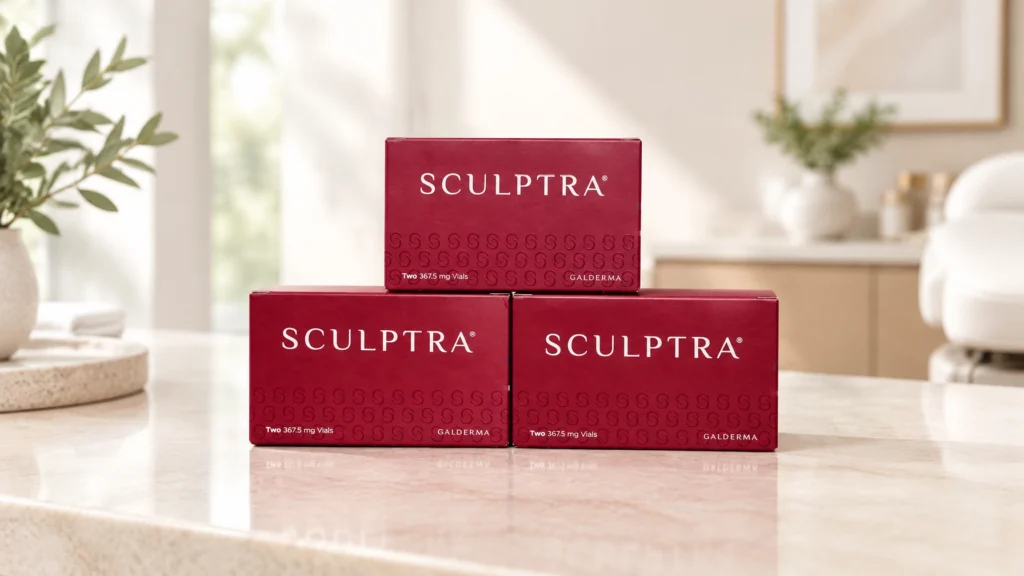
Sculptra is a biostimulator. It contains poly-L-lactic acid (PLLA), which encourages your body to produce collagen over time. Rather than acting as a ready-made contouring gel, it supports gradual changes in facial volume and tissue structure. The effect develops as your body responds, so you won’t see the final result immediately.
HA filler adds volume directly. It’s a gel placed in selected areas to create support or definition. For the jawline, an appropriate product and precise placement can provide a more immediate change in contour.
In short: Sculptra is a gradual build; HA filler is more like targeted, immediate structure. Neither is automatically the better option. They’re designed for different goals.
When might Sculptra suit your jawline goals?
Sculptra may be worth discussing if your concern is a softer, less supported look through the lower face, along with changes in skin quality or mild laxity. As collagen develops, the result may create a subtle improvement in support and the appearance of contour. It’s not the same as drawing a crisp line along the jaw with gel.
At Uplift Aesthetics, Sculptra treatment information describes a typical plan of 2–3 sessions, with the exact plan based on an individual consultation. Results develop gradually, and Uplift notes they may last 2+ years. That’s a general expectation, not a promise: your response and treatment plan can vary.
It’s also important to understand the treatment’s FDA labeling. Sculptra is FDA-approved for certain facial wrinkles and the cheek region, but direct jawline injection is not listed as a separate FDA-approved indication. A provider may discuss jawline use as an off-label approach, weighing the potential benefit, evidence, and limitations with you. The FDA’s Sculptra information explains its approved cheek-region use and notes that study participants received up to four injections.

When might HA filler be the better match?
If your main goal is a more visible, defined jawline, HA filler may be a more direct option to discuss. An injector can place it strategically to support areas such as the jaw angle or lower jaw border. You’ll generally see added volume soon after treatment, although swelling can affect the early appearance.
Some HA products have a jawline-specific FDA indication. For example, the FDA says JUVÉDERM VOLUX XC is indicated for adults over 21 with moderate to severe loss of jawline definition, and results may last up to 12 months. Other products and treatment areas can have different expected durations. In general, HA filler commonly lasts around 6–12+ months, depending on the product, placement, and individual factors. Your provider can explain which product is appropriate for your treatment plan.
Many people have filler in one appointment, though a follow-up or touch-up may be recommended. HA filler is often described as adjustable, and some products can be dissolved with an enzyme called hyaluronidase. That does not make filler risk-free or guarantee every concern can be immediately or completely reversed. The FDA’s JUVÉDERM VOLUX XC page summarizes its jawline indication, expected duration, and safety information.
Sculptra vs. HA filler: a quick comparison
| Sculptra | HA filler | |
|---|---|---|
| How it works | Encourages gradual collagen production | Adds gel volume directly |
| How results appear | Builds over time | Visible soon after treatment, with early swelling possible |
| Common treatment pattern | Often a series; Uplift notes 2–3 sessions are typical | Often one appointment, sometimes with a follow-up |
| May suit goals such as | Subtle support and gradual improvement in skin quality or mild laxity | More targeted, immediate contour definition |
| General longevity | Uplift lists results lasting 2+ years; not guaranteed | Often 6–12+ months, depending on product and placement |
| Jawline-specific FDA labeling | Direct jawline use is not a separate FDA-approved indication | Some products, including VOLUX XC, have a jawline indication |
Think of this as a starting point, not a way to diagnose yourself in the mirror. Two people can describe the same concern (“my jawline looks softer”) but need different plans based on anatomy, skin, and the result they want.
What about safety and natural-looking results?
Both treatments involve injections, so choosing a qualified, trained provider matters. Temporary tenderness, swelling, bruising, or redness can occur. Sculptra also carries a risk of delayed bumps or nodules. With facial injectables, rare but serious complications can occur if product affects a blood vessel. Ask about risks, aftercare, and what to do if you have unexpected symptoms.
HA filler’s ability to be dissolved is one difference worth discussing, but it doesn’t remove the need for careful product selection and placement. Sculptra, meanwhile, works gradually and is not treated like a gel that can simply be dissolved. Your provider should make sure you understand the trade-offs before choosing either option.
Natural-looking filler isn’t about choosing the most product. It’s about matching the treatment and placement to your features and goals. A conservative plan may be more appropriate than trying to create a dramatic edge in one visit. Skin tone alone doesn’t decide whether treatment is right for you; your clinician should consider your health history, anatomy, skin, and individual risk factors.
Why a consultation makes the difference
At a consultation, your injector can look at your face from different angles, discuss what you notice, and clarify whether you’re seeking gradual support or more immediate definition. They can also explain whether Sculptra jawline treatment is appropriate for your specific goals, whether HA filler may be a closer fit, or whether neither is recommended.
If you’re exploring Sculptra in St. Paul or dermal filler, Uplift Aesthetics offers consultations for clients in the St. Paul area, including Woodbury. At a Woodbury med spa, you should feel comfortable asking questions, taking time to decide, and hearing a realistic explanation of benefits and limitations.

The bottom line
Sculptra and HA filler can both be part of a lower-face rejuvenation plan, but they are not interchangeable. Sculptra works gradually by stimulating collagen and may suit someone seeking subtle support over time. HA filler adds volume directly and may be a better conversation for someone who wants more defined contour sooner.
Keep reading, asking questions, and focusing on what feels like you. A thoughtful consultation can help you weigh the options and choose a plan that fits your features, preferences, and schedule, without pressure to decide on the spot.